Notch, peak or shawl?
A lapel frames the shirt and face, but it also helps establish what kind of garment you are wearing. Notch, peak, and shawl describe three familiar shapes. Each can look right when its proportions and context are considered. Choosing among them is less about finding the one correct answer for your body and more about understanding the role of the jacket.
Begin with the occasion and the complete outfit. A jacket for regular business use, a double-breasted suit, and a dinner jacket need not make the same choice. Look at the shoulder, button position, chest, pockets, and trousers together. A lapel chosen in isolation can seem convincing in a close-up photograph and less settled when the entire garment is in view.
The notch lapel
The notch is the opening where the collar meets the lapel. It is a familiar choice on single-breasted suits and sport coats and can be a practical starting point for a versatile wardrobe. Its relative restraint allows cloth, fit, and accessories to carry more of the visual interest. That does not make it an unconsidered default; its dimensions still deserve attention.
Notice the angle of the notch, the height at which it sits, and the width of the lapel. Small changes can affect the expression of a jacket. A very narrow lapel and a fuller one do not create the same balance, even on otherwise similar garments. Try the whole jacket before deciding that a measurement seen online is the measurement you need.
The peak lapel
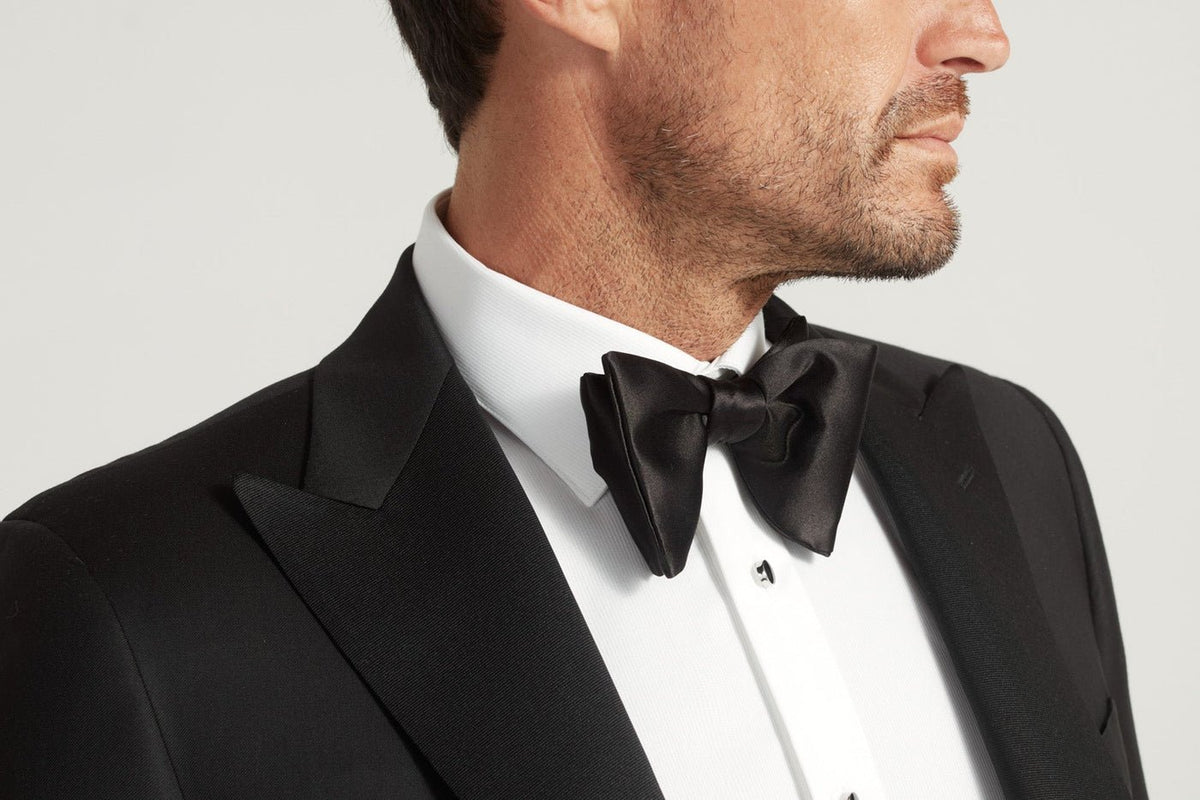
A peak lapel points upward toward the shoulder where it meets the collar. It is strongly associated with double-breasted tailoring and is also used on single-breasted suits and eveningwear. The upward line can make the jacket feel more assertive. Whether that is desirable depends on the occasion and your preference, not on a universal rule that peak lapels are always more flattering.
Look at how the point sits in relation to the shoulder and chest. On some jackets, the shape is broad and expressive; on others, it is more restrained. The rest of the garment should support the choice. If you prefer a quiet cloth and a simple shirt, the lapel can provide enough character without adding another prominent detail elsewhere in the outfit.
The shawl collar
A shawl collar forms a continuous curve without a notch or peak. It is a familiar option for dinner jackets and other evening garments. Its smooth line creates a different effect from the angles of a peak lapel. Compare both if you are choosing eveningwear: one may feel more natural with the complete outfit, even if you arrived with a firm preference.
The width and curve matter just as much as the category name. Look at the collar while the jacket is fastened and while you move. Consider the shirt front, bow tie, and trouser proportions. The goal is a coherent evening outfit. There is little benefit in selecting a detail because it appears formally correct if the resulting garment feels uncomfortable or disconnected from the rest of what you wear.
Width is a relationship
Lapel width should be judged against the jacket rather than a trend in isolation. The shoulder line, chest, waist shaping, and button position all influence how much visual space a lapel occupies. A garment with more fullness can support different proportions from a very narrow silhouette. The wearer's preference also matters; confidence in a familiar shape is not a trivial consideration.
A useful fitting-room exercise is to step back from the mirror. Close-up inspection encourages you to concentrate on a single number or edge. From a normal conversational distance, the overall balance becomes clearer. Take a straight-on photograph if it helps, but remember that lens position and distance can distort proportion. Use the image as one reference, not a final verdict.
The roll and the front of the jacket
The lapel's roll is the way it curves into the jacket front. It is influenced by the garment's design and construction. A flat drawing cannot fully describe it. See how the lapel lies when the jacket is buttoned as intended. Pulling at the closure, a collar that stands away, or an unsettled front may indicate a fitting issue rather than a problem with the lapel category.
Ask the fitter to separate those questions. Changing from notch to peak will not solve every issue in the chest, and choosing a wider lapel will not automatically improve the shoulder. It is easier to judge style after the basic fit is credible. Work from the structure of the garment toward its details rather than expecting a detail to repair the structure.
Match the occasion without overcomplicating it
For a first business suit, a well-proportioned notch lapel is a useful place to begin the discussion. For a double-breasted suit, a peak lapel may be part of the intended character. For eveningwear, compare peak and shawl options in the context of the stated dress code. These are starting points, not instructions to ignore the actual garment in front of you.
If you are dressing for a wedding, clarify your role and the hosts' expectations before choosing. A guest should not assume the same freedom as someone setting the wedding party's clothes. A dress code can narrow the decision considerably. If the invitation is unclear, asking the hosts is more reliable than trying to infer the answer from the venue alone.
Keep the final decision simple
Once fit, occasion, and proportion are settled, choose the version you are likely to enjoy wearing. There is no need to turn every tailoring decision into a test of expertise. A lapel should help the outfit feel resolved. It should not become the reason you hesitate to wear a suit that otherwise works.
At Wm. Fox, bring the occasion, a shirt you plan to wear, and any reference photographs to the conversation. Explore suits, browse eveningwear, or request a fitting. We can look at the complete garment together instead of reducing the choice to three names on a list.